
How to Hire a Machine Learning Engineer (Without Wasting Time or Money)


AI is evolving fast, but hiring the right talent to build with it? That’s a different story. Thanks to the rise of foundation models and the explosion of accessible tools—from open-source libraries to plug-and-play APIs—companies of all sizes are now experimenting with AI. However, turning those prototypes into real, scalable products takes a very different kind of team.
Table Of Contents
- Why Hiring Top Machine Learning Engineers Is a Whole Different Challenge
- Understanding the Role of a Machine Learning Engineer
- Data Scientist vs. Machine Learning Engineer
- Evaluating Candidates: Prioritize Real-World Experience Over Theory
- How Much Does It Cost to Hire a Machine Learning Engineer?
- How to Find the Right Machine Learning Engineer
- How to Write a Job Post That Actually Attracts ML Engineers
- Common Mistakes When Hiring an ML Engineer (and How to Avoid Them)
- Final Thoughts
The demand for machine learning engineers is expected to grow over 40% between 2023 and 2027. But there’s a problem: a lot of companies jump in without a clear plan for who they actually need. Do you need someone who can fine-tune models? Ship production code? Evaluate tradeoffs between off-the-shelf APIs and custom models? The answer depends on where you are in your AI journey—and it’s easy to get it wrong.
In this post, we’ll unpack what to consider before hiring a machine learning engineer: what skills actually matter, how to assess candidates (even if you’re not technical), what compensation looks like right now, and where the real challenges tend to show up.
Why Hiring Top Machine Learning Engineers Is a Whole Different Challenge
Hiring is almost always difficult, regardless of the role. But hiring a great Machine Learning Engineer is a different level of hard. There’s a few reasons for this.

First, the fundamentals are still evolving. AI and machine learning technologies are evolving fast; what was cutting-edge two years ago might be outdated today. Additionally, the pool of people who can actually build, deploy, and maintain real-world systems is small—and highly specialized.
It doesn’t help that many ML roles require years of hands-on experience just to reach competency, let alone mastery. And because these skills are in such high demand, top candidates are often already employed, earning competitive salaries and fielding multiple offers.
Still, that doesn’t mean hiring is hopeless. You just need to get clear on the type of ML talent you actually need—and where they’re likely to be. In the next section, we’ll break down how to define the role and set realistic expectations before you ever start sourcing.
Understanding the Role of a Machine Learning Engineer
What Does an ML Engineer Actually Do?
“Machine Learning Engineer” is a broad title. The actual day-to-day can vary wildly depending on the company, the product, and the maturity of the data infrastructure. At a high level, ML engineers are responsible for building systems that learn from data and make decisions in the real world. They sit at the intersection of data science and software engineering—translating algorithms into usable, scalable products.
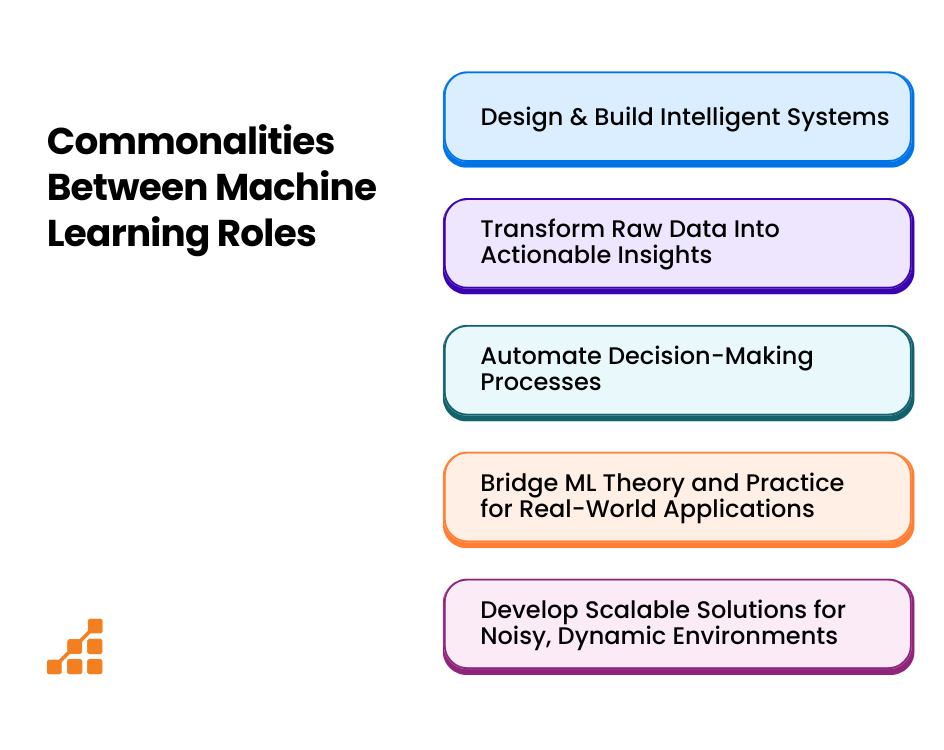
Despite the diversity in what ML engineers do, there are some things that most have in common:
- Design and build intelligent systems that learn from data
- Transform raw data into actionable insights through applied algorithms
- Automate decision-making processes using production-grade AI models
- Bridge theory and practice, turning ML research into real-world business applications
- Develop scalable solutions that can handle noisy, dynamic environments
Common Job Titles You Might See
Depending on the company, tech stack, or even who wrote the job description, ML-related roles can show up under a variety of titles. Some are interchangeable. Others imply different levels of research, engineering, or operations focus.
Here are a few common ones:
- Machine Learning Engineer
- AI Engineer
- Data Scientist
- Research Engineer
- MLOps Engineer
- Deep Learning Engineer
- NLP Engineer (for language-specific work)
Each of these job titles comes with a slightly different scope. If you’re not sure what you’re looking for yet, don’t worry—let’s start by breaking down the two most commonly confused roles: the Data Scientist and the ML Engineer.
Data Scientist vs. Machine Learning Engineer
It’s common to mix up these roles, and for good reason. They often share overlapping skill sets—both often work with Python, ML libraries, and large datasets. They may also use similar tools and platforms, from scikit-learn to TensorFlow to cloud-based notebooks. And job titles are still being defined.
At a glance, these roles might look similar—but their day-to-day work is fundamentally different. The key distinction between data scientists and ML engineers is in their focus.
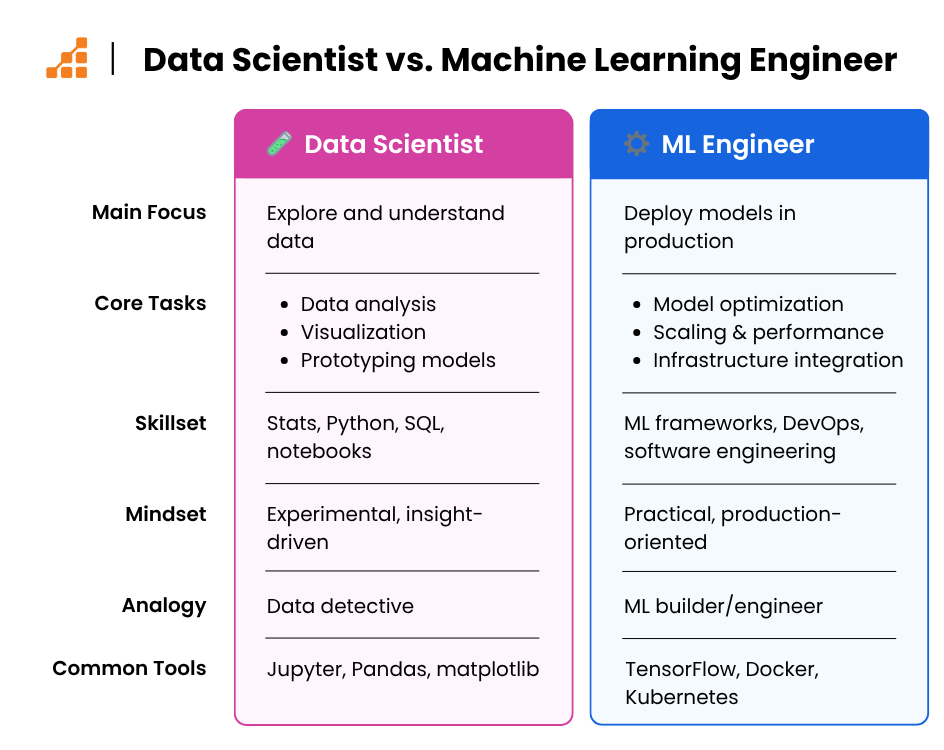
Data Scientists focus on understanding the data. They explore, analyze, and visualize datasets to uncover patterns, trends, and insights that help drive better decisions. They’re often responsible for building initial model prototypes to test hypotheses—think of them as detectives who specialize in investigating data and generating ideas from it.
Machine Learning Engineers, by contrast, take those ideas and turn them into reality. Their job is to make models production-ready: scalable, performant, and integrated into your existing systems. They combine deep knowledge of machine learning with strong software engineering skills to deploy systems that can operate reliably in the real world.

It’s also worth mentioning that the line between these roles isn’t fixed. Many professionals move between data science and ML engineering roles over the course of their careers. The transition depends on technical skillset, project needs, and whether someone wants to lean more into experimentation or engineering over time.
A Quick Analogy: LEGO Brains and Builders
Imagine you’ve got a massive pile of LEGO bricks. A Data Scientist is the one sorting through the pieces, figuring out what’s possible, and suggesting that you could build a robot, a house, or a car.
The ML Engineer is the one who takes that idea and actually builds a LEGO robot—one that can build LEGO houses on its own. They’re the architect, engineer, and builder rolled into one.
Why You Might Need an ML Engineer—Not Just a Data Scientist
In many projects, a data scientist is your starting point. They explore the data, identify opportunities, and prototype models that show what’s possible. But turning those prototypes into real, production-ready systems is a different challenge altogether.
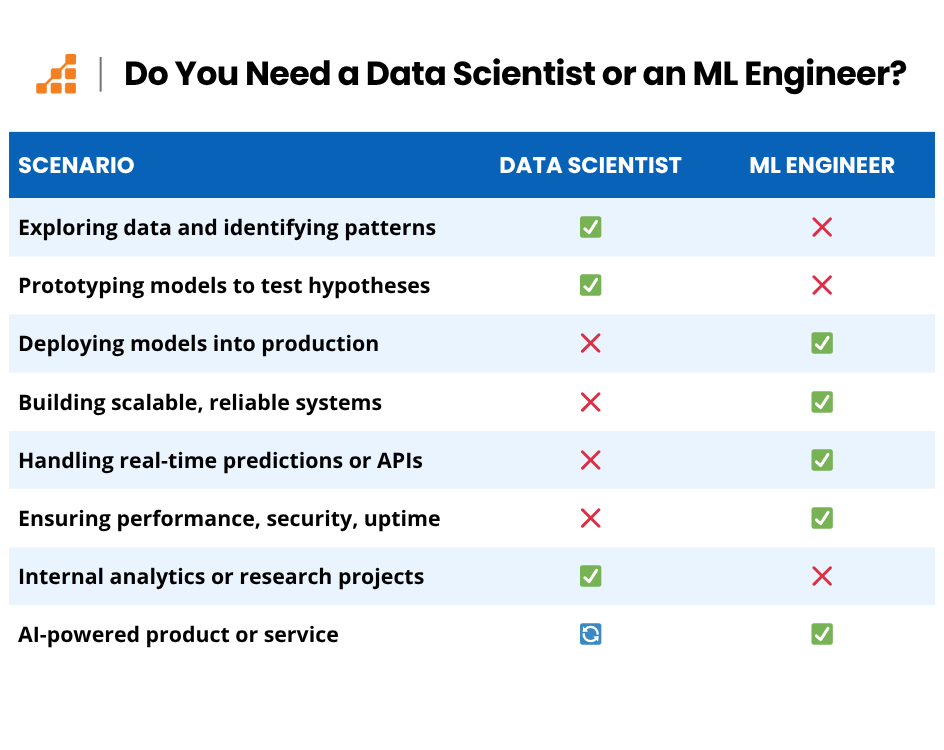
That’s where the ML engineer comes in.
If your goal is to deploy models—to serve predictions to users, integrate with your product, handle real-time traffic, or meet reliability and security standards—you’ll need an ML engineer. They’re the ones who can take a Jupyter notebook and turn it into a robust, scalable API that holds up under real-world pressure.
That said, you don’t always need both. For early-stage projects, internal analytics, or research-heavy initiatives, a data scientist might be enough. But if you’re building an AI-powered product or service, having engineering expertise on the team isn’t optional.
Evaluating Candidates: Prioritize Real-World Experience Over Theory
In machine learning, shipping a model that works in production is often more valuable than building one that works in a classroom. Degrees and certifications might show foundational knowledge—but they won’t tell you whether someone can handle messy data, flaky pipelines, or tight product deadlines.
When evaluating candidates, focus on practical experience. Look for engineers who’ve been in the trenches—who’ve built and deployed models, debugged them in production, and navigated the tradeoffs that come with scaling real systems.
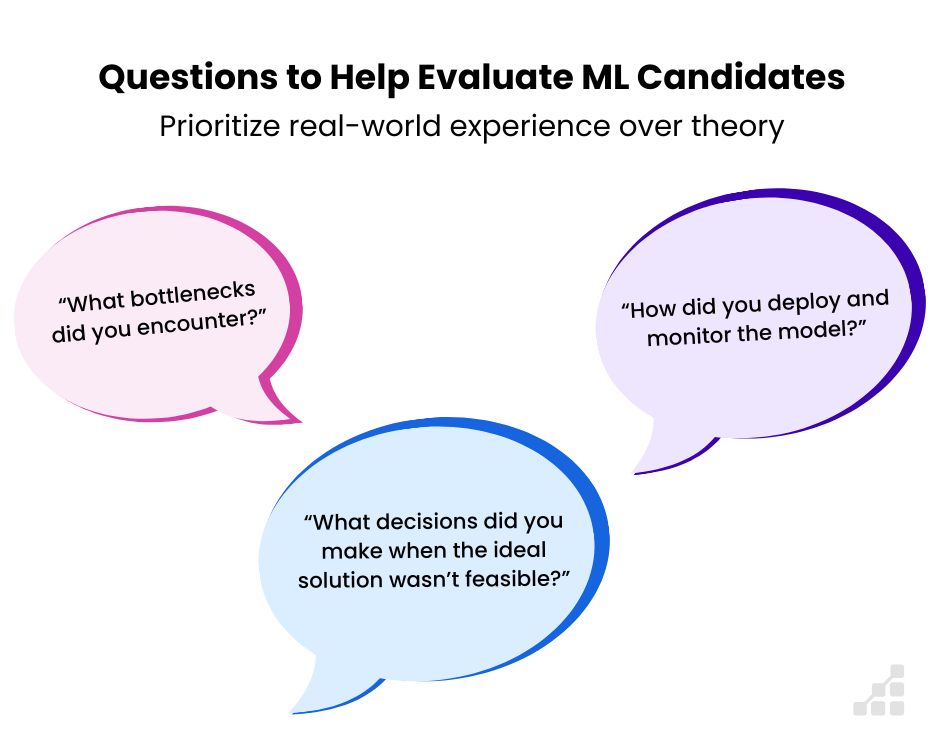
In interviews, ask about specific project scenarios:
- What bottlenecks did they encounter?
- How did they deploy and monitor the model?
- What decisions did they make when the ideal solution wasn’t feasible?
The best ML engineers can walk you through these stories in detail—and explain the why behind their choices.
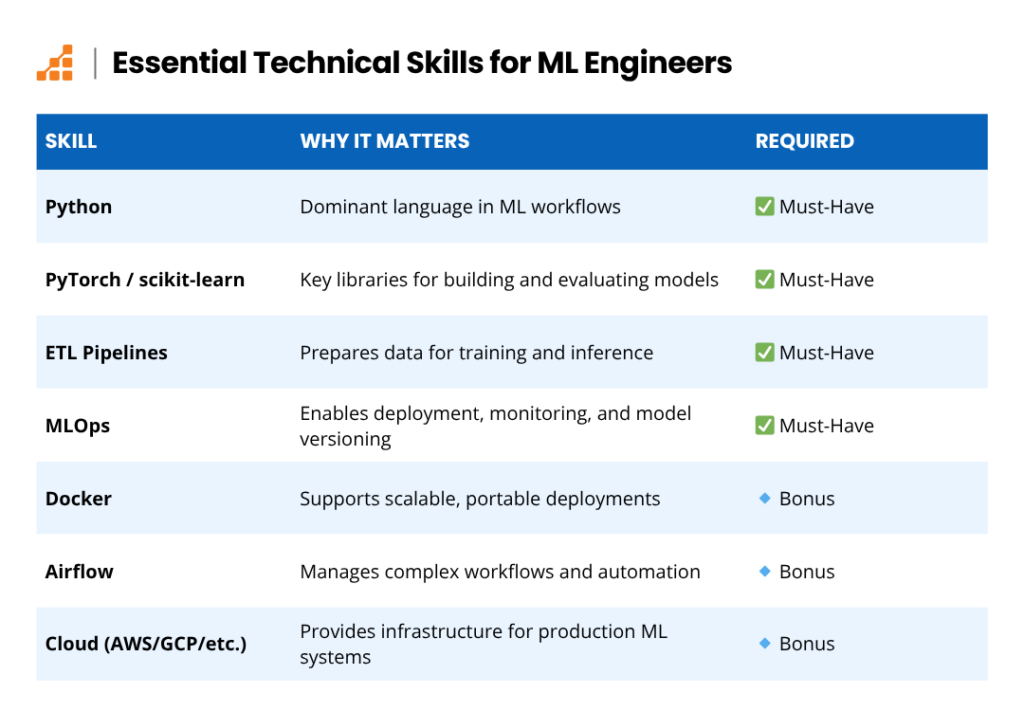
Must-Have Technical Skills for ML Engineers
While every ML engineer’s toolkit will vary depending on the domain, some skills are table stakes:
- Python – still the dominant language in the ML ecosystem
- Key libraries – deep experience with tools like PyTorch and scikit-learn
- ETL pipelines – strong understanding of how to collect, clean, and structure data
- MLOps fundamentals – experience with deployment, monitoring, and versioning of models in production environments
Bonus points for familiarity with containerization (Docker), workflow orchestration (Airflow), and cloud-based infrastructure (AWS/GCP/Azure).
The Best ML Engineers Aren’t Just Coders
Hard skills matter. But as Scalable Path’s CEO put it, “great developers aren’t just technically competent—they’re also strong communicators, team players, and problem solvers.” This applies even more in machine learning, where engineers often sit between data scientists, product managers, and software teams.
Look for candidates who:
- Ask thoughtful questions
- Can explain complex concepts clearly
- Adapt quickly to new tools and evolving priorities
Mindset and collaboration skills are what turn a technically competent hire into a long-term asset for your team.
Why Curiosity and Adaptability Matter More Than Knowing the “Right” Tools
ML tools, libraries, and frameworks change constantly. According to IBM, many niche technical skills are now considered outdated in as little as 2.5 years [3]. That means hiring someone just because they know PyTorch or TensorFlow isn’t enough. What you really want is someone who’s curious, adaptable, and has a track record of learning on the fly.
Look for candidates who:
- Stay up to date with new tools and trends
- Tinker with new libraries outside of work
- Can talk through how they’ve evolved their stack over time
If they’re learning for the sake of learning—not just when forced to—they’ll be much better equipped to handle whatever changes are coming next.
How to Assess a Candidate’s Learning Mindset
One of the simplest ways to surface adaptability is to ask about recent learnings:
- What’s the last new ML or Python tool you learned?
- How did you apply it?
- What did you stop using because of it?
This gives you a window into how they think—and how proactive they are in keeping their skills current. No single answer will tell you everything, but if they’re excited to talk about their process, that’s a good sign.
Avoid hiring for static expertise. Instead, hire people who treat learning as part of the job.
How Much Does It Cost to Hire a Machine Learning Engineer?
Salaries for ML engineers vary a lot—not just by experience, but by geography, role expectations, and company size. A senior engineer working in-person in San Francisco will cost significantly more than someone working remotely from Eastern Europe or Latin America. In some cases, the difference can be 2–3x, even for candidates with similar capabilities.
That said, paying more doesn’t always mean you’re getting someone better. What matters most is clarity: knowing exactly what you need and hiring accordingly.
Here are a few things to consider:
- Seniority: Junior engineers can help with implementation, but you’ll need mid to senior-level experience to design and scale production systems.
- Location: Remote work has made global hiring more viable. Many excellent ML engineers live outside traditional tech hubs—and are open to freelance or contract work.
- Engagement type: If you’re not ready for a full-time hire, contractors and freelancers can help you validate ideas, ship prototypes, or fill temporary gaps without long-term overhead.
- Equity: For early-stage startups, offering equity can help attract strong candidates even if cash compensation is limited.
Before setting your budget, map out what kind of impact you need this person to have in the next 6–12 months. That’ll guide whether you’re looking for a full-time team member, a fractional contributor, or a short-term consultant.
How to Find the Right Machine Learning Engineer
As we’ve discussed, it’s not easy to hire an ML engineer. In this section, I’ll bring some points that can be useful in the search for good candidates.
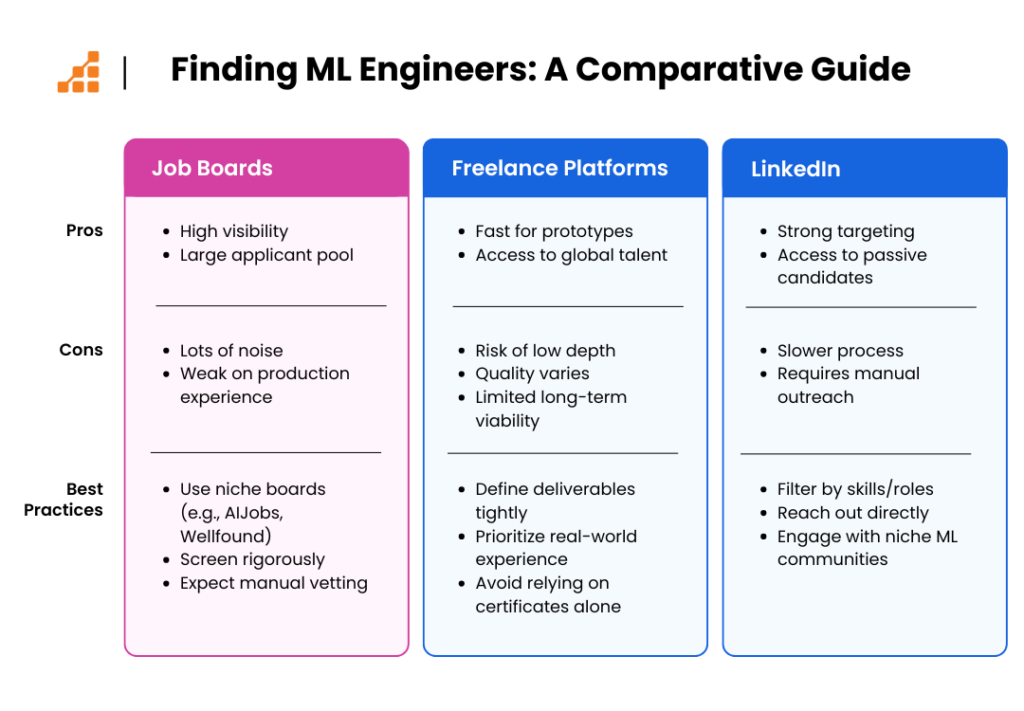
Job Boards: High Volume, Low Signal
Traditional job boards like Indeed or Glassdoor can surface a wide range of candidates—but that can also be a problem. You’ll often get flooded with applications from people who don’t have production-level experience or who simply keyword-stuffed their resumes.
If you go this route:
- Stick to specialized job boards (like AIJobs or Wellfound for startups)
- Be prepared to screen heavily
- Expect to do more technical vetting yourself
Job boards can work, but they’re rarely efficient if you need someone high-skill and low-maintenance.
Freelance Platforms: Good for Prototypes, Risky for Long-Term Work
Platforms like Upwork or Toptal can be useful for quick experiments or proof-of-concept builds. But don’t expect plug-and-play engineering excellence.
What to watch for:
- Many freelancers are generalists with limited depth in ML
- Projects often go sideways due to unclear scopes or unrealistic timelines
- Quality varies wildly—even on “curated” platforms
If you use this method, define your deliverables very clearly and prioritize candidates with verifiable production experience—not just courses and certificates.
LinkedIn: Slower, But More Targeted
LinkedIn isn’t built for hiring ML engineers—but it’s one of the best places to source proactively, especially if you know what you’re looking for.
If you go this route, here are some tips:
- Use filters to target by skills, past roles, and location
- Reach out directly—the best candidates won’t be applying cold
- Engage with ML-focused groups and niche communities
This route takes more time, but it’s often where you’ll find the most qualified and currently employed engineers—especially those who aren’t actively job hunting.
A Faster, Smarter Way to Hire: Scalable Path
If all of this sounds like a lot—it is. Hiring the right Machine Learning engineer takes time, technical insight, and a clear understanding of your project’s goals.
That’s why we built Scalable Path: to help companies find and work with top-tier machine learning and AI engineers, without getting buried in bad resumes or wasting weeks on interviews that go nowhere.
Our network includes rigorously vetted ML specialists with proven experience building real-world systems. We handle the sourcing, screening, and project fit—so you can focus on building. If you’re looking for someone to hit the ground running, get in touch and we’ll help you find the right person.
How to Write a Job Post That Actually Attracts ML Engineers
If you want to hire serious talent, skip the buzzwords and boilerplate. The best ML engineers aren’t scanning job boards looking for “rockstars” or “ninjas”—they’re looking for real problems to solve.
Instead of listing every ML buzzword under the sun, write a job post that answers these questions:
- What business problem are we solving?
- Why does it matter?
- What will the ML engineer actually do on a daily basis?
- What tools and infrastructure are already in place (if any)?
- Who will they work with—and what does success look like in the first 3–6 months?
You don’t need to promise moonshots. Just be honest about the scope and opportunity.
Pro tip: If your job post looks like it was copied from a generic HR template, it’ll get treated like one.
The strongest candidates are drawn to clarity, impact, and purpose—not jargon. Show them how their work will matter, how your team makes decisions, and what kind of autonomy they’ll have.
Common Mistakes When Hiring an ML Engineer (and How to Avoid Them)
Hiring a machine learning engineer is high-stakes. Getting it wrong can set your project back months. Here are three of the most common mistakes we see, and how to steer clear of them.
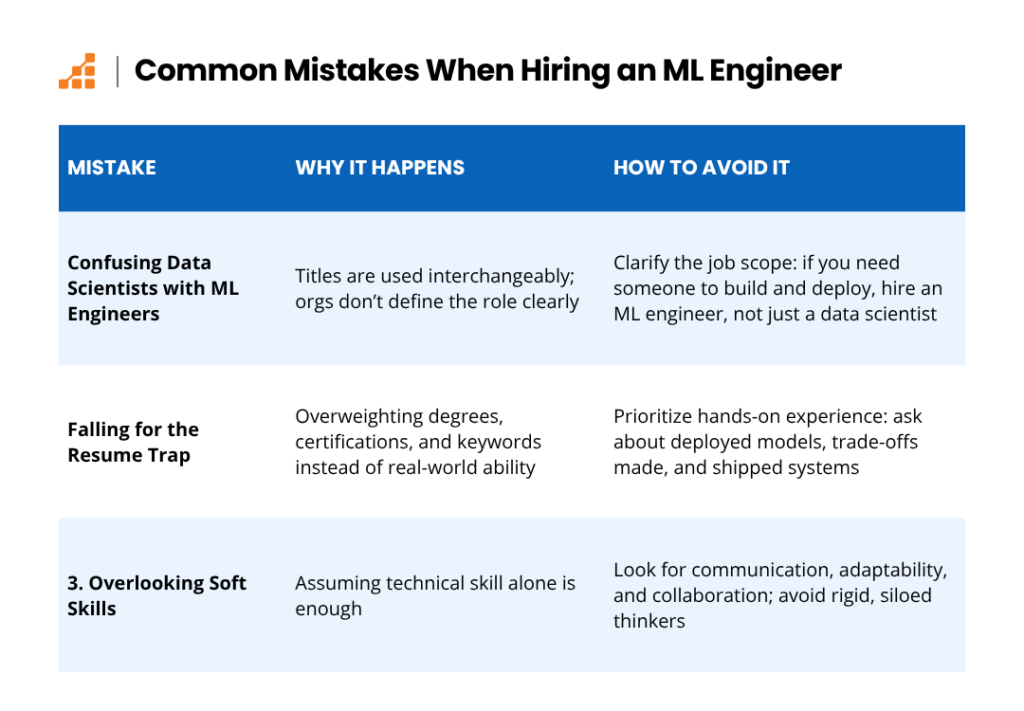
1. Confusing Data Scientists with ML Engineers
It happens all the time: companies hire a data scientist when what they really need is someone who can deploy and maintain production systems. If your goal is to integrate ML into your product, a data scientist alone won’t get you there. Make sure you’re hiring for the actual job, not just the title.
2. Falling for the Resume Trap
Degrees and certifications can be a nice signal, but they’re not enough. In machine learning, real-world experience is far more important than academic pedigree.
Ask yourself:
- Have they deployed models into production?
- Can they explain trade-offs they made under real constraints?
- Do they have a track record of shipping, not just studying?
Don’t get blinded by the resume. Focus on what they’ve built.
3. Overlooking Soft Skills
Strong communication isn’t a “nice to have;” it’s essential. ML engineers often sit between data scientists, product teams, and engineering leads. If they can’t explain their work, collaborate effectively, or adapt to change, your project will suffer.
Red flags:
- Rigid thinking
- Poor communication
- Inability to give or receive feedback
You want someone who’s not just technically solid, but also collaborative, curious, and comfortable in fast-moving environments.
Final Thoughts
Hiring a machine learning engineer isn’t easy. And it shouldn’t be. The role sits at the intersection of data science, software engineering, and real-world problem solving. It requires not just technical depth, but the ability to build systems that actually work at scale, in production, and under pressure.
Whether you’re hiring for the first time or refining your team, the key is clarity: know what you need, where your gaps are, and what kind of person can move the needle. That means looking past the buzzwords, ignoring resume bait, and focusing on real experience, adaptability, and impact.
And if you’re not sure where to start—or don’t want to spend months searching—there are partners who can help. At Scalable Path, we’ve spent years helping companies find ML engineers who can actually deliver.